Second Temple Jewish Paideia in Context by Jason M. Zurawski Gabriele Boccaccini
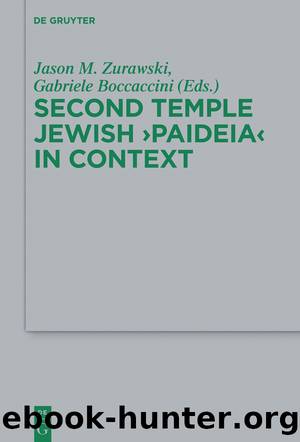
Author:Jason M. Zurawski, Gabriele Boccaccini
Language: eng
Format: epub
Publisher: Walter de Gruyter
Published: 2017-02-15T00:00:00+00:00
Conclusion
Due to constraints of space I have had to condense an argument that requires considerably more elaboration. Yet, I hope to have indicated some reasons for abandoning the time-honored dichotomy between philosophy and religion when applied to the ancient world. From an etic point of view, philosophy constituted a sub-category of religion. That does not preclude philosophical criticism over and against other forms of religion, but it is pivotal to understand that this criticism was formulated from the perspective of what we, from a contemporary scholarly view, interpret as religion. On the basis of biocultural evolutionary considerations, which have long been neglected, if not directly disavowed, in the humanities and social sciences, we have noted how the emergence of philosophical discourse in ancient China and Greece closely resembles parallel developments in the field of what we are more accustomed to think of as religion proper, in the context of ancient Indian and Israelite religion. In that regard, the three textual examples chosen here for comparison may be advantageous in opening our eyes to a greater fluidity and blurriness between what we commonly understand as philosophical and religious discourses in the ancient world.
The examples represent different locations on the scale of ancient Jewish paideia. By their share in Graeco-Roman philosophical traditions, these texts have frequently been understood as a surrendering of Judaism to foreign culture or exemplifying a Graeco-Roman veneer fundamentally determined by an underlying Jewish foundation. Contrary to such a view, whether formulated as âJudaism lightâ and âHellenism heavyâ or, alternatively, âHellenism lightâ and âJudaism heavy,â I endorseâin the wake of Sahlinsâan understanding of culture according to which it is predominantly foreign in origin but distinctively local in pattern. Thereby, I avoid the problematical game of making the gain of Hellenism a loss of Judaism and vice-versa. Although the Jewish textual manifestations looked upon here closely resemble traditions found in Graeco-Roman philosophy may appear to us as a form of cultural blending, they were hardly understood in this manner by their adherents. Rather, they were conceived to represent the truest forms of Judaism.
The examples are representative of three highly specific and internally different manifestations of Jewish paideia. Although it may be difficult to designate Wisdom as philosophy proper, it reflects the same fundamental epistemological structure that we find in the genuine philosophical discourses. The text constitutes a borderline phenomenon that enables us to see the ambiguity pertaining to our distinction between philosophy and religion with regard to the ancient world. Yet, the text testifies to several of the characteristics highlighted as particularly prominent in the transition from archaic to axial religiosity. When we proceed to 4 Macc, we find a philosophical protreptic discourse aimed to demonstrate how devout reason is the master of passion, and how this reason finds its only true expression in the Torah. Similar to the results of Wisdom, 4 Macc pays witness to key features in the transition from archaic to axial and post-axial age religiosity. Unlike the Philonic corpus, however, 4 Macc is not an
Download
This site does not store any files on its server. We only index and link to content provided by other sites. Please contact the content providers to delete copyright contents if any and email us, we'll remove relevant links or contents immediately.
Professional Troublemaker by Luvvie Ajayi Jones(29643)
Empire of the Sikhs by Patwant Singh(23062)
Twilight of the Idols With the Antichrist and Ecce Homo by Friedrich Nietzsche(18608)
Plagued by Fire by Paul Hendrickson(17394)
The Sun and Her Flowers by Rupi Kaur(14497)
Norse Mythology by Gaiman Neil(13320)
A Journey Through Charms and Defence Against the Dark Arts (Harry Potter: A Journey Throughâ¦) by Pottermore Publishing(9264)
Fangirl by Rainbow Rowell(9216)
Adultolescence by Gabbie Hanna(8904)
Wonder by R.J. Palacio(8558)
Tools of Titans by Timothy Ferriss(8350)
Becoming Supernatural by Dr. Joe Dispenza(8188)
How to Bang a Billionaire by Alexis Hall(8131)
Wonder by R. J. Palacio(8090)
Crystal Healing for Women by Mariah K. Lyons(7916)
The Road Less Traveled by M. Scott Peck(7576)
The Lost Art of Listening by Michael P. Nichols(7482)
The Witchcraft of Salem Village by Shirley Jackson(7244)
The Institute by Stephen King(7016)
